Caregiver Wellbeing
Protect the Heroes who protect our Patients.
Healthcare workers face extraordinary pressures: adverse events, moral injury, vicarious trauma, and chronic stress. Beterra's Care for Caregivers module gives organizations the tools to monitor caregiver wellbeing, deploy structured peer support, and take targeted action before burnout becomes a crisis.
Caregiver burnout is a patient safety issue, and most organizations have no system to address it.
The research is clear: burned-out clinicians make more errors, leave their organizations, and are at higher risk of serious mental health events. Yet most health systems have no structured program to catch distress early or connect caregivers to support when it matters most.
Burnout is invisible until it's too late
By the time burnout shows up in turnover or incidents, the warning signals were there for months, unseen and unaddressed.
No structured peer support program
Peer support exists informally at best, with no system to deploy it, track it, or ensure clinicians in distress actually get connected.
Managers are on their own
Frontline managers want to support their teams but have no practical tools, and adding more to their workload only makes things worse.
Wellbeing data sits apart from safety culture
Caregiver distress signals and safety culture survey data live in separate systems, and no one sees the full picture until something goes wrong.
What Care for Caregivers Solves
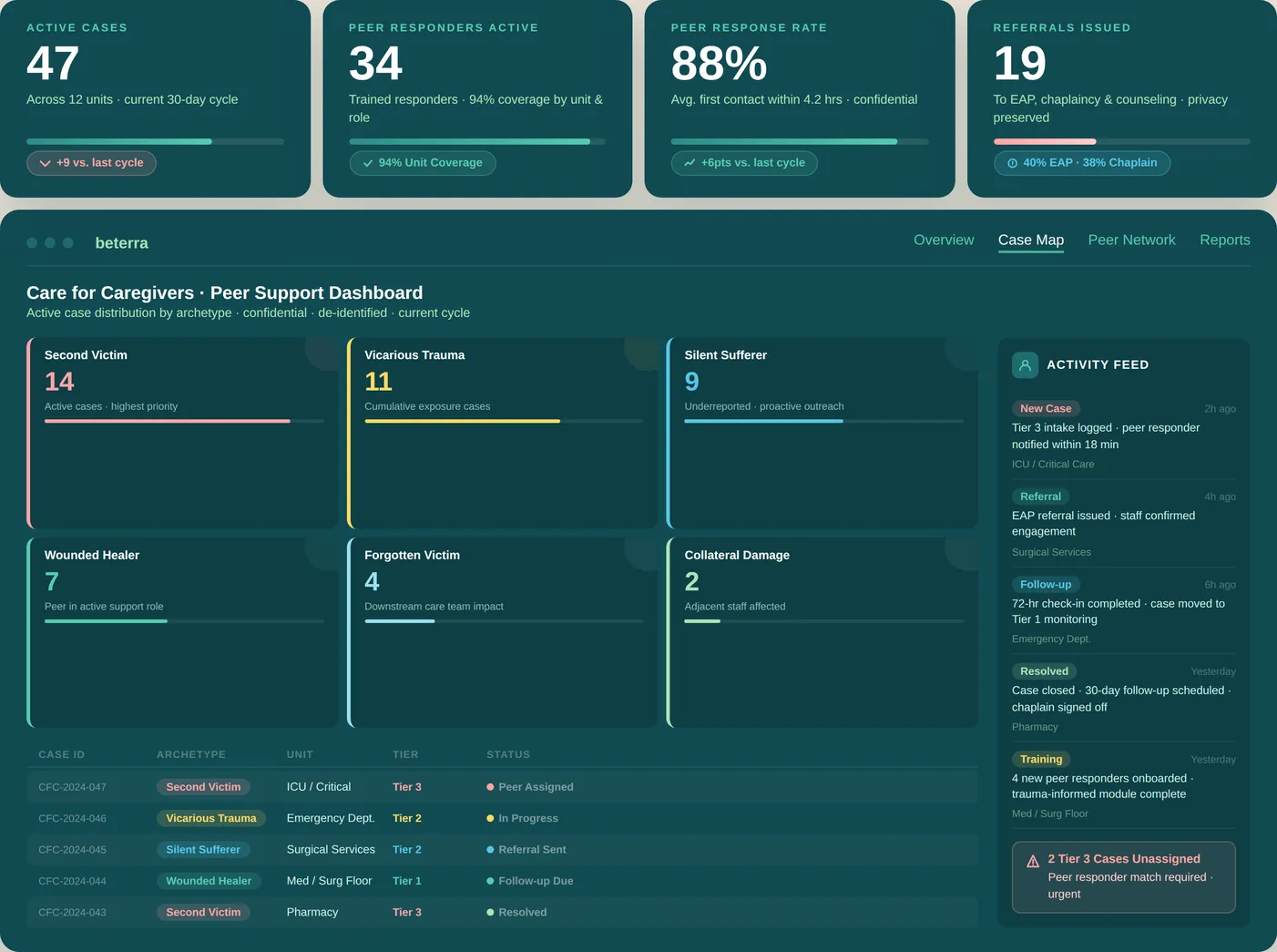
Operationalizes peer support for caregiver distress and second victim experiences with standardized workflows, confidentiality, and measurable follow-up.
Built different, by design.
Most organizations handle caregiver wellbeing with an EAP hotline and good intentions. Beterra is purpose-built for the clinical environment, grounded in evidence-based frameworks.
How it works today
- - EAP hotline few people actually call
- - Burnout caught only after it shows
- - Managers have no practical tools
- - Wellbeing and safety data disconnected
Generic wellness platforms
- - Not built for clinical environments
- - No second victim framework
- - No tiered support structure
- - No safety culture connection
Care for Caregivers
- Built on Scott Three-Tiered Model
- Second victim framework built in
- Manager toolkits that fit existing workflows
- Connected to safety culture data automatically
The Framework Behind the Product
Built on the Scott Three-Tiered Model — by the people who developed it.
The Scott Three-Tiered Model is the evidence-based framework adopted by hundreds of hospitals to structure peer support for second victims. Beterra didn't adapt it to fit our software. Dr. Susan Scott — the model's creator — is on our team.
Clinical Advisor, Beterra
Dr. Susan Scott
Creator, Scott Three-Tiered Model
Dr. Scott pioneered the second victim framework now adopted by healthcare organizations worldwide. Her Three-Tiered Model gives clinicians a structured, dignified pathway to recovery after adverse events — and it is the clinical backbone of everything Beterra's Care for Caregivers module does. She didn't consult on this product. She helped build it.
Manager & Supervisor Support
Frontline managers provide immediate, day-to-day emotional support and reassurance using structured toolkits built into existing workflows — not an added burden on already-stretched leaders.
Peer Support
Trained peer supporters — clinicians who have navigated difficult experiences themselves — provide confidential, structured support for colleagues in distress. Beterra manages peer rosters, activation, and case logging.
Professional & Specialized Referral
Pre-built referral pathways connect caregivers to EAP, chaplaincy, social work, and clinical psychology — quickly, privately, and with full continuity of care documentation.
Everything your organization needs to support the people behind patient care.
Confidential peer support pathways
Deploy structured Tier 2 peer support that gives clinicians a trusted, confidential avenue to process difficult experiences and return to high-quality care.
Burnout risk monitoring
Identify at-risk individuals and units early through integrated data signals, so managers can intervene before burnout becomes attrition or an incident.
Manager toolkits for action
Give Tier 1 frontline managers practical, evidence-based tools to provide reassurance and day-to-day support without adding to their workload.
Expedited referral network
Tier 3 referral pathways to EAP, chaplain, social work, and clinical psychology, pre-built and ready to deploy when caregivers need deeper support.
Safety culture data connection
Caregiver wellbeing signals surface alongside SafeCulture and OneCulture survey data, showing the full picture of staff health in one place.
System-wide wellbeing tracking
Health system leaders see caregiver wellbeing trends across all facilities, identifying where support is most needed before it becomes a system-wide crisis.
How it Works on the ACT Platform
Four structured phases take your organization from strategy to sustained caregiver support.
Plan
- · Assessment & Core Team Formation
- · Build Organizational Strategy
- · Communication Planning and Rollouts
- · Policy, Process, and Support Tools
Onboard
- · Onsite and Virtual Leadership Training
- · Peer Selection and Onboarding
- · Engagement Dashboard Activation
Operationalize
- · Launch ACT C4C Tools & Processes
- · Measurement Dashboard & Monitoring
- · Support Coaching
Sustain & Improve
- · C4C Program Assessment
- · Peer Network Maintenance
- · C4C Program Strategy Revision
Grounded in Evidence and Real-World Practice
Second Victim research shows most clinicians will experience emotional distress during their career. Structured support reduces burnout, turnover, and the patient safety risks that follow.
81%
Experience troubling memories or intrusive thoughts after adverse events
76%
Report anxiety or fear of future events without structured support
68%
Report loss of confidence or concentration affecting their practice
25%
Leave their organization within a year without formal peer support
Ideal for Healthcare Organizations
Designed for health systems, hospitals, ASCs, and care networks seeking a scalable, confidential, and measurable caregiver support system.
Hospitals and Health Systems
Enterprise peer roster, board-ready governance reporting, and system-wide wellbeing dashboards at scale.
Ambulatory and Specialty Care
Flexible peer pools with rapid activation and streamlined workflows that fit outpatient and specialty environments.
Nursing and Post-Acute
Sustain well-being and retention across shifts, with tools built for the unique pressures of long-term and post-acute care.
Academic and Teaching
Integrate peer support with simulation, training, and supervision - building a culture of psychological safety from day one.
Caregiver wellbeing connected to the full safety picture.
Care for Caregivers doesn't sit in isolation - it connects to every Beterra module, because caregiver wellbeing is inseparable from patient safety and quality outcomes.
Pulls from SafeCulture & OneCulture
Survey scores surface burnout risk signals automatically, connecting culture data to the Three-Tiered support pathway in real time.
Learn more →Pulls from Leader Rounding
Recognition captured during rounds flows into caregiver support workflows, and rounding data flags Tier 1 wellbeing concerns early.
Learn more →Feeds Quality View & PI Projects
Systemic wellbeing issues surface in Quality View and can trigger PI projects, connecting caregiver health directly to patient safety improvement.
Learn more →Lives in the ACT Platform
One login, one source of truth. Care for Caregivers sits inside the same hub as every other Beterra workflow.
Learn more →Invest in the people who invest in patients.
See how Care for Caregivers strengthens your workforce, reduces the hidden costs of caregiver distress, and connects wellbeing directly to patient safety outcomes - built on the Scott Three-Tiered Model your clinical team already trusts.